While we were in Saint Remy we walked the Van Gogh Trail up to the hospital where he lived in 1888 and 1889. I spent a lot of time thinking about his paintings and made a few observations that are helping me, so I thought I would pass them along. These are in no particular order, just thoughts as I recorded them in my journal. Here are also a few paintings I did this week while the inspiration was fresh.
Colors in the painting do not have to match the view. I realized that I often am too fussy trying to duplicate the colors that I see. Van Gogh didn’t seem to worry about that. He seems to at times exaggerate the colors. For example. distant hills do have bit of blue in them, that is due to the atmosphere filtering out the yellow. He often painted the hills in bright blue.
In one of his letters to Theo he points out that the olive trees change color from green to blue, to gray depending on the time of day. Monet would paint for a few minutes on a canvas then put it away until the next day at the same time because the color changed and he wanted to capture a certain color.
Erin Hill, a sketcher in Australia, says she paints landscapes in the colors she wants them to be. All of this is to say that I learned a new freedom from Van Gough regarding colors.

Brush strokes for texture and shape. Van Gogh used brush strokes to highlight the textures of trees, fields, even buildings and clothing, something most oil and acrylic painters do. What I realized is that he also did that in his watercolor and pencil sketches.
In the above painting I used the pen for more texture in the distant hills as well as the trees and foreground.
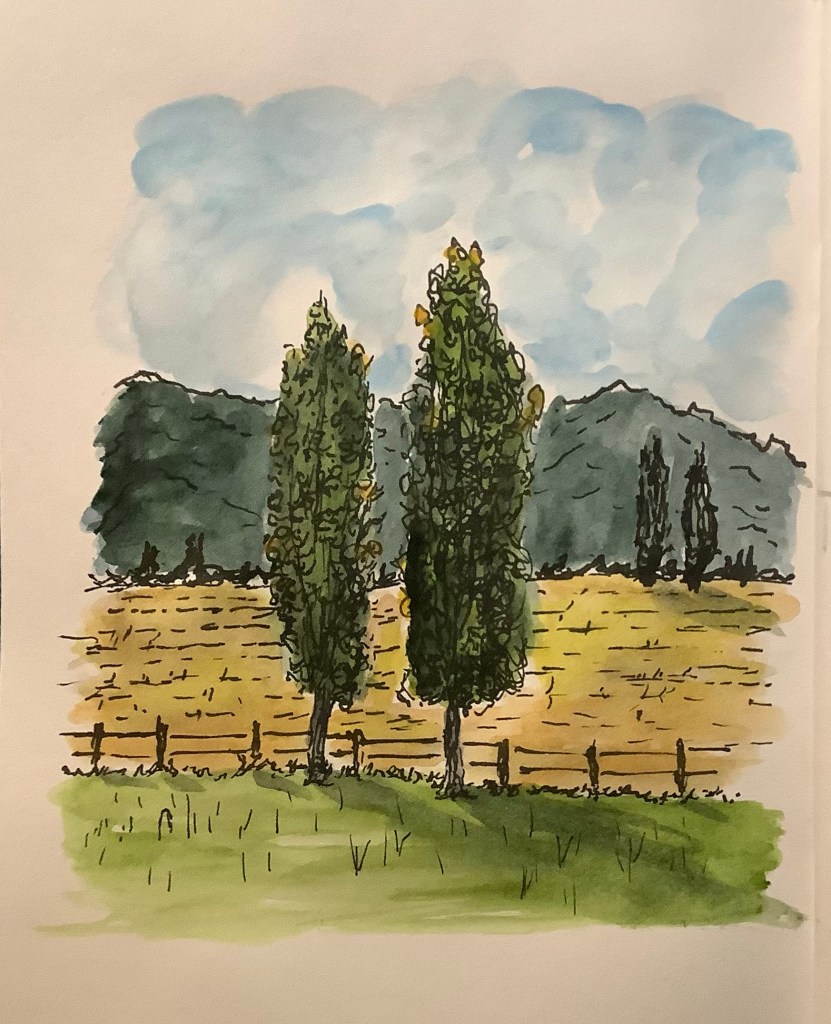
Mixed media is a good thing. I don’t know where I got the idea that one must be a purist, using only watercolor, only gouache, only acrylic, etc. Some of that comes from articles I have read where people indirectly imply that mixed media is somehow secondary. Even art shows promote this concept. They have categories for oil, for acrylic, for watercolor, and then mixed media is separate. But Van Gogh just used whatever made it work for him at the moment.
So I now have my watercolor pallet, and my gouache pallet all the time, and use both on the same sketch. Sometimes it just works better that way. Purist watercolor folks say white should only come from leaving unpainted areas so the paper can show through. that is fine for them, but white gouache on top of watercolor works well, as does an acrylic paint pen, or a jell pen.
Art is all about constant learning and experimenting. So I encourage the painters that read this to give something new a try.
 theTravelsketcher
Very interesting post. Thanks for sharing.
LikeLiked by 1 person
Very informative
LikeLiked by 1 person
We never stop learning and discovering new things. Lovely sketches!
LikeLiked by 1 person
thank you so much.
LikeLiked by 1 person
Travel Sketcher, you are constantly learning and experimenting in your art. I so admire that, and want to replicate this philosophy in my life. Well… constantly learning, yes. Constantly experimenting? Hmmm… gotta keep myself from getting too crazy, as is my wont.
LikeLike
I have always admired people who are capable of getting pen to paper and paint to paper and being able to give us a, aperçu of this world that surrounds us. I feel fake when I see this kind of ability, only being able to offer photographs as an alternative. That is a very special talent you have there!
LikeLiked by 1 person
Ian, I do think most can do a bit of sketching. I did workshops just for people who said they had no talent, I bet you could do something.
LikeLiked by 1 person
I dabbled at one stage and it helped me with my photography in seeing the world in tones. I used to sketch with mines de plomb and loved it. it would seem however that pushing a button on a camera is,way easier…
LikeLiked by 1 person
Easier, possibly, but I like the interaction with a place that sketching brings, both arts are such wonderful things.
LikeLike
It’s totally different. I can get caught up in a location and take my photos almost on instinct. I tend to be an instinctive photographer and somewhat of an opportunist. If it’s not golden hour, well you just get out there and deal with the light that you get. The work starts when you get home and develop your films or get the photos from the camera to the computer. Then the editing starts. You can start transforming what you saw into what you felt….
LikeLiked by 1 person
Love that. My wife, http://www.travelsthroughmylens.com is a lot like you. She deals with what is there.
You caught my eye with “developing film” back in my photo days we used bulk film that we loaded into canisters. I even remember developing color slides, eleven different solutions, one with +- 0.5 F temp range. Those were some fun days.
LikeLiked by 1 person
Developping film is always something that is eye catching, and I still love seeing the negs for the first time off the spool. Colour development is slightly different with less margin for error in temperature. Black and whit film is still “accessible” as far a price is concerned, and saves time doidng black and white conversions. You get the effect right away. I have just followed Madame!
LikeLiked by 1 person
I did always love the process. We used Tri-x film in those days, is it still around?
LikeLiked by 1 person
Definitely still around and aailable. I have a little left. Otherwise Ilfor HP5, Kentmere, Foamapan, and if I’m in the mood Rolei (because the negs come out really flat so great for scanning…
LikeLike